
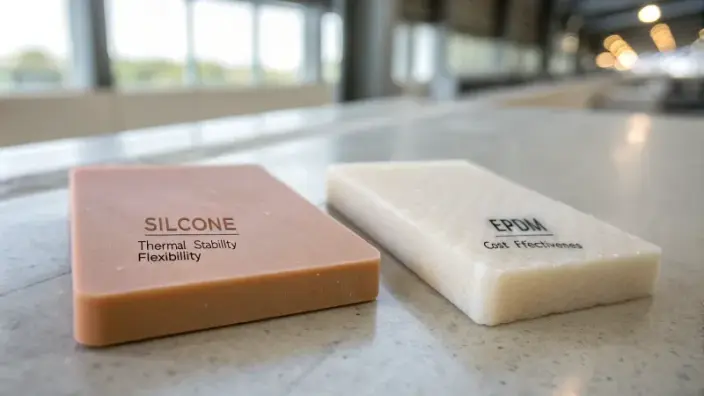
Silicone and EPDM should be compared for a defined application, not ranked as universal winners. For a seal, start with the fluid or environment, temperature exposure, movement and required service life; then compare specific compounds and supplier data.
“Silicone handles heat” and “EPDM is for outdoors” are starting points for a discussion, not enough information to approve a part. A material-family name does not specify a formulation, hardness or finished-product performance.
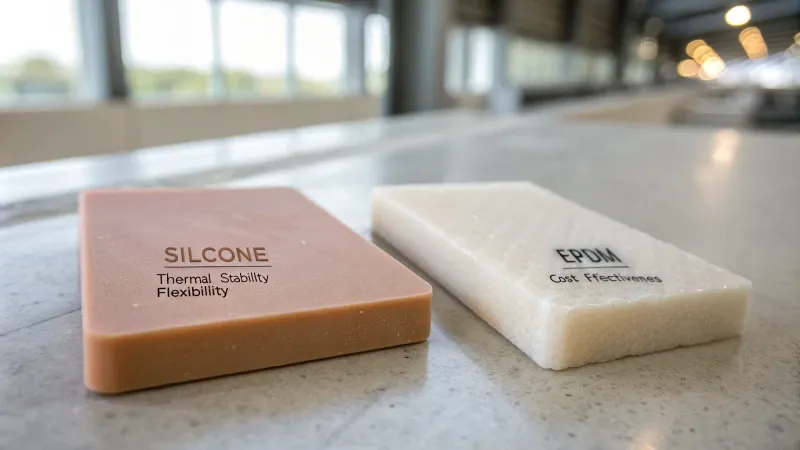
What should a like-for-like comparison contain?
| Selection question | Evidence to request for each candidate |
|---|---|
| What contacts the rubber? | Exact medium, concentration and exposure conditions; supplier compatibility guidance |
| How hot or cold does it become? | Continuous and short-duration limits for the proposed compound and application |
| Is the part static or moving? | Seal geometry, load, friction and wear requirements |
| Will it be used outdoors? | Relevant weathering, ozone and UV evidence for the compound |
| How must it recover after compression? | Compression-set data with the test temperature, duration and method |
| Does it contact food or serve another regulated use? | Applicable formulation and finished-product documentation for that use and market |
Do not transfer results for an O-ring compound directly to a roof membrane, hose, bakeware item or another formulation. Their geometry, loads and acceptance criteria differ.
How should temperature limits be compared?
Use the same kind of exposure and failure criterion on both sides. A short-duration maximum is not a continuous service rating. Air, hot water, steam and a process fluid can require different limits, even at the same indicated temperature.
The Parker O-Ring Handbook is a reference for sealing-material selection. Use the entry for the proposed compound and the handbook’s application limitations rather than treating a family-level range as a product guarantee. Confirm the current data with the material or seal supplier before specifying a temperature limit.
Shin-Etsu’s silicone rubber properties guide, in its heat-resistance discussion, distinguishes performance over time and different silicone grades. Those examples explain why temperature and duration belong together; they do not establish the limits of an unspecified SANNYIN product.
What about chemicals and outdoor exposure?
Evaluate the actual medium and environment. Do not describe either material as resistant to all oils, acids, steam or outdoor conditions. Shin-Etsu’s sections on moisture, steam, oils and solvents describe different responses to different exposures; a single “excellent chemical resistance” label hides this distinction.
For a seal, ask the supplier to check compatibility at the intended concentration and temperature. Where compatibility data do not represent the service conditions, agree a validation test on the proposed compound. For outdoor parts, define the exposure, appearance and mechanical properties that must remain acceptable.
Which material is more cost-effective?
Compare quotations for parts meeting the same requirements. Include tooling, compound, process, inspection, replacement and any required testing. A lower raw-material price does not establish a lower cost for the finished application, and this article does not provide current comparable quotations.
Ask both suppliers to identify what their quote covers. Material substitutions, special testing and a change in service conditions should trigger a new technical and commercial review.
What should you send for material selection?
Provide the drawing, intended function, contact medium, temperature profile, motion or compression, target market and acceptance criteria. If an existing part has failed, include the actual exposure history and failure description rather than assuming that changing material family will solve it.
For silicone manufacturing enquiries, contact SANNYIN with those inputs. Approve a material and sample for the application before committing to production.
Revision note: Removed unverified personal anecdotes, repeated generic temperature tables and unsupported rankings; retained the sealing-handbook reference with application limits and added a supplier-material reference.