
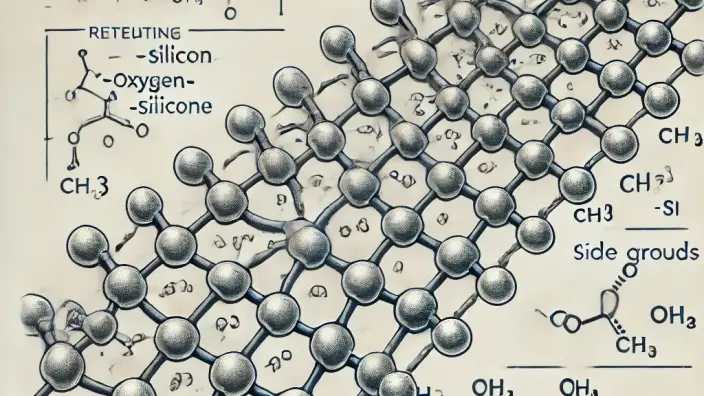
Silicones combine an inorganic silicon–oxygen backbone with organic groups attached to silicon. Describing that structure is more accurate than giving an unqualified “organic” or “inorganic” answer. In chemistry, “organic” describes the carbon-containing groups in this discussion; it does not establish natural origin, food-contact suitability, or environmental performance.
The University of Wuppertal’s chemistry teaching material places silicones between typical organic and inorganic compounds. The Global Silicones Council, an industry body, describes their inorganic backbone and direct silicon–carbon bonds to organic groups. These descriptions concern different parts of the same structure, rather than contradictory material identities.
Silicones have an inorganic backbone and organic substituents.True
The backbone contains alternating silicon and oxygen atoms; carbon-containing groups are attached to silicon. Classifying the backbone alone does not describe the entire polymer.
What Is the Difference Between Silicon, Silica, and Silicone?
These names refer to different substances. The Royal Society of Chemistry’s silicon reference distinguishes the element, its oxide, and silicone polymers.
| Term | Chemical meaning | Why the distinction matters |
|---|---|---|
| Silicon | The chemical element Si | Silicon atoms occur within many compounds; the element is not silicone rubber. |
| Silica | Silicon dioxide, SiO₂; quartz is one form | Silica is a silicon–oxygen compound without the organic side groups of silicone. |
| Silicone | A family of synthetic siloxane polymers | Common methyl silicones have silicon–oxygen chains with carbon-containing methyl groups attached. |
Silica can be a starting material in the industrial route to silicon, which is then used in silicone manufacture. That origin does not make the resulting polymer chemically identical to sand. A finished silicone rubber compound can also contain fillers and other ingredients; its composition cannot be reduced to the name of its base polymer.
Why Does Silicone Have Both Organic and Inorganic Features?
A common example is polydimethylsiloxane, or PDMS. Its repeating chain alternates silicon and oxygen, and the silicon atoms bear methyl groups. A methyl group contains carbon and hydrogen. The organic groups are therefore part of the polymer even though carbon does not form its main chain.
The distinction is between backbone chemistry and side-group chemistry. “Inorganic backbone” describes the silicon–oxygen chain. “Organosilicon” describes chemistry involving silicon–carbon bonds. “Hybrid organic–inorganic” is a useful description of how silicone combines these structural features. These terms should not be compressed into “silicone contains no organic material.”
Silicone is also a material family: fluids, gels, resins, and cured rubbers do not have identical formulations or performance. The Global Silicones Council’s structural overview supports that family description, not a universal temperature limit or a guarantee of chemical inertness for every product.
A silicon–oxygen backbone means silicone contains no carbon.False
Common silicones contain carbon in groups attached to silicon. The composition of the main chain does not describe all atoms in the polymer.
Does “Organic” Establish Product Safety?
No. Chemical classification does not demonstrate that a finished spatula, seal, or medical component is suitable for a particular use. Nor does a synthetic origin by itself establish that a product is unsafe. The relevant evidence concerns the exact formulation, manufacturing process, contact conditions, and intended application.
For example, 21 CFR 177.2600 sets conditions for certain rubber articles intended for repeated food contact, including composition and finished-article extractives requirements. It is not a finding that all silicone articles release nothing; its scope also excludes nursing-bottle nipples.
The German Federal Institute for Risk Assessment’s method for silicone consumer products measures volatile-compound release under specified laboratory conditions. The existence of such a test is a reason to request applicable product evidence, rather than infer zero migration from the polymer’s backbone.
Silicone’s chemical classification proves that every silicone product is safe for food contact.False
Classification describes molecular structure. Food-contact suitability requires evidence for the formulation and finished article under its intended conditions of use.
Does the Classification Establish Environmental Performance?
No. Neither the inorganic backbone nor the organic side groups prove biodegradability, compostability, recyclability, or zero particle release. Those are separate questions requiring evidence about the material, exposure conditions, and disposal route.
In particular, chemical stability must not be translated into “cannot fragment.” Our article on silicone and microplastic release distinguishes physical particles from molecular migration and explains the limits of the available experimental evidence. A claim that one finished product has a lower environmental impact than another would also need a defined comparison across manufacture, actual reuse, and end of life.
Conclusion
Silicone is best explained here as a synthetic siloxane material with an inorganic backbone and organic substituents. Keep silicon, silica, and silicone distinct, then assess safety and environmental claims using evidence relevant to the finished product. The word “organic” cannot answer those application questions.
Revision scope: corrected the chemical classification and terminology; removed unsupported universal safety, temperature, and environmental comparisons.