
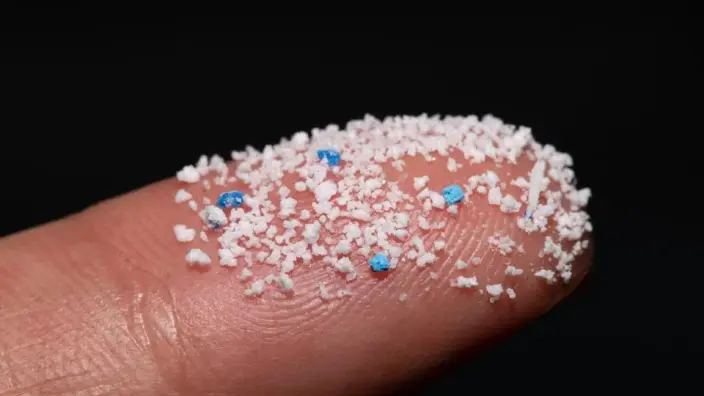
Silicone rubber can release small polymer particles under some tested conditions. Its silicon–oxygen backbone does not justify a universal “no microplastics” claim. A laboratory release finding also does not establish the everyday release rate, environmental exposure, or health risk of every silicone product.
A 2023 study by Ekvall and colleagues generated nanoparticles from silicone pacifier material using an immersion blender. That is direct evidence against zero-release claims, with an important limit: severe mechanical breakdown is not a measurement of normal use for a spatula, baking mold, or every pacifier.
Silicone rubber cannot release small polymer particles.False
A mechanical-breakdown study produced nanoparticles from the tested silicone pacifier material. The result establishes a possibility under those conditions, not a release rate for every product or use.
What Do Microplastics, Wear, and Degradation Mean?
NOAA describes microplastics as plastic pieces smaller than five millimeters, including fragments from larger debris. Scientific and regulatory definitions can differ; a release study must identify the material and size range it actually measures. Calling a material “silicone” rather than “plastic” does not establish that no particles can detach from it.
Silicone is a family of synthetic polymers with silicon–oxygen backbones and organic groups attached to silicon, as explained in the Royal Society of Chemistry’s silicon reference. Silicon is an element, silica is silicon dioxide, and silicone rubber is a polymer material. These terms are not interchangeable.
| Process or result | What it describes | What it does not establish |
|---|---|---|
| Abrasion or mechanical fragmentation | Physical removal or breakup of material into smaller pieces | Complete chemical decomposition or biodegradation |
| Chemical degradation | Changes in the polymer’s chemical structure | That the material has disappeared or become harmless |
| Particle release | Detached material in a measured size range | A universal release rate or a health-risk conclusion |
| Molecular migration | Transfer of individual substances, such as low-molecular-weight siloxanes | A count of solid microplastic particles |
| Biodegradation | Breakdown through biological activity | The same outcome as fragmentation or specialized recycling |
A cured rubber does not have to melt before it can be cut, abraded, or fragmented. Heat resistance and resistance to wear are different properties.
What Has Research Actually Shown?
Ekvall and colleagues tested silicone and latex pacifier material using five minutes of immersion blending. They characterized the resulting particles with several techniques. Their silicone samples released nanoscale particles after mechanical breakdown; boiling beforehand increased release during subsequent breakdown.
The same paper reported that boiling alone did not produce a significant number of nanoparticles under its test conditions. That qualification matters: neither the positive mechanical result nor the boiling result is a universal statement about all forms of heating, silicone formulations, particle sizes, or analytical methods.
This article has no measurements for particle release from a specific SANNYIN product. The cited experiment does not establish an environmental emission factor for silicone kitchenware or a consumer exposure estimate. Those remain unknown here.
Release results must be interpreted with their test conditions.True
Mechanical breakdown and boiling alone gave different results in the cited study. Product, treatment, particle-size window, and analytical method constrain what a result supports.
Is Particle Release the Same as Chemical Migration?
No. A material can release molecules without visibly breaking apart, and a particle study does not by itself identify all migrating chemicals.
For example, Liu and colleagues’ baking-mold study tested silicone oligomer migration into food simulants under specified conditions. Its abstract describes inadequately post-cured samples. It supports a finding for those samples and tests; it does not show that all silicone bakeware behaves identically. Oligomer migration must not be presented as a particle count, or its absence inferred from an undamaged appearance.
What About Disposal and Environmental Comparisons?
Do not treat fragmentation as evidence that cured silicone rubber is readily biodegradable or compostable. This article provides no product-specific evidence establishing either outcome. It also provides no defensible universal time for silicone to disappear in a landfill.
Recycling requires a specialist collection or processing route that explicitly accepts the material. Such routes are limited and availability must be checked locally; do not assume a household plastics collection accepts silicone. Confirm accepted product types and contamination limits with the operator before sending used items.
Repeated use may avoid replacement items, but that alone does not prove a lower overall environmental impact. A fair comparison needs equivalent function, manufacturing inputs, actual service life, washing, transport, and end-of-life assumptions. No such comparative lifecycle assessment is established here, so silicone cannot be declared environmentally superior to all other plastics or materials.
For a particular product, request evidence that matches its formulation and likely stresses: cleaning, abrasion, heat, repeated use, and eventual disposal. Follow its care instructions and replace damaged items according to the manufacturer’s guidance. These practices are not a guarantee of zero release.
Conclusion
The evidence supports a conditional answer: silicone rubber can form and release small polymer particles under tested mechanical breakdown. The available evidence here does not quantify everyday release or environmental risk for every product. Durability, chemical migration, biodegradation, and recycling must each be assessed on their own evidence.
Revision scope: replaced the zero-release claim with scoped research findings; separated particles, migration, and degradation; removed unsupported safety and environmental-superiority guarantees.