
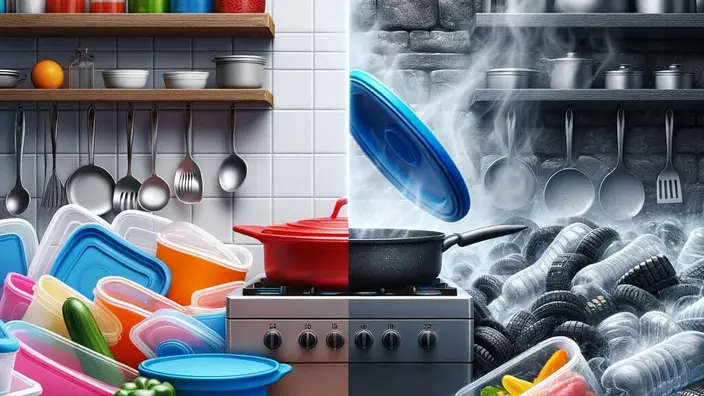
Silicone is not automatically safer than every plastic for food contact. Compare specific finished articles under the same food, temperature, contact time and reuse conditions. A silicone mold documented for oven baking and a plastic container documented for refrigerated storage solve different tasks; neither establishes a general safety ranking.
The question is whether an identified article is suitable for its intended use. This article does not provide comparative migration results for particular silicone, polypropylene (PP), polyethylene (PE) or polyethylene terephthalate (PET) products.

What Does a Fair Food-Contact Comparison Require?
“Plastic” covers many polymers and formulations. “Silicone” also covers different formulations, curing systems and finished products. The material name cannot identify every additive, processing residue or contact limitation.
The FDA explains that food-contact regulatory status depends on each substance in the article and its intended use. It identifies three parts of an authorization to consider: substance identity, specifications and limitations on use. Food Contact Substance Notifications also have manufacturer-specific scope.
This does not mean all raw materials used in silicone are FDA-approved, nor that a general silicone designation certifies a finished utensil. The same component-by-component and use-specific reasoning applies to plastic food-contact articles.
Every silicone food-contact article is safer than every plastic article.False
No material-family label establishes a comparative safety result. The identified formulations and articles must be assessed for the same food-contact conditions.
How Do Food, Heat and Contact Time Change the Decision?
The FDA’s food-type and condition-of-use tables distinguish acidic, aqueous, fatty and other foods, along with refrigerated storage, room-temperature storage, reheating and cooking. A document covering one condition cannot automatically be applied to another.
| Intended task | Specific comparison to make | Evidence needed |
|---|---|---|
| Refrigerated food storage | A named silicone container versus a named PP, PE or PET article intended for that storage use | Intended foods, duration, closure suitability and applicable food-contact documentation for both |
| Microwave reheating | An identified silicone article versus an identified plastic article explicitly intended for reheating | Instructions for the container and lid, permitted foods and heating conditions; material identity alone is insufficient |
| Oven baking | An oven-rated silicone mold versus a particular alternative documented for the same oven use | Finished-article temperature and duration limits, use restrictions and applicable contact evidence |
| Repeated use and washing | Two identified reusable articles | Reuse and cleaning instructions, condition after use, and evidence covering the intended repeated-contact application |
These are comparison designs, not findings that one named polymer is suitable for all of the listed tasks. In particular, storage suitability does not establish reheating or oven suitability.
What Does Silicone’s Heat Resistance Establish?
Silicone rubber’s flexibility and heat resistance can be useful for molded kitchen articles. But a material surviving heat is different from a food-contact formulation meeting its applicable requirements.
Shin-Etsu’s silicone-rubber technical manual, “Heat and cold resistance,” p. 4, states that heat resistance varies with the formula and curing agent, and describes different deterioration in air and sealed conditions. It does not give a universal food-contact safe temperature for silicone cookware.
A “platinum-cured,” “BPA-free” or “food-grade” label is not a complete comparison. A cure-system description does not supply migration data. The absence of one specified substance does not demonstrate the absence of every possible migrant, nor that a competing plastic article contains that substance. Ask which requirement the statement addresses and which product and use it covers.
A product's heat-resistance rating and its food-contact documentation answer different questions.True
The supplier manual describes mechanical deterioration, while FDA guidance addresses substance identity, specifications and intended contact conditions. One does not replace the other.
What Documents Should a Buyer Request?
Request evidence for the actual article and destination market:
- A clear manufacturer and product identifier, with the relevant formulation or grade linked to the documentation.
- Instructions identifying permitted food contact, heating methods, temperatures, duration, cleaning and repeated use.
- The applicable regulatory basis and a compliance statement whose scope matches that product and intended use.
- Relevant test reports where required, identifying the sample, test method, food simulants, exposure conditions and results. A resin sample or differently colored formulation may not represent the supplied assembled article.
The FDA says a buyer may ask a manufacturer for a letter of guaranty for a particular product’s intended food-contact use. That is a useful request for defined evidence, rather than a material-wide “FDA approved” assurance. Requirements in another market must be checked separately.
No product-specific comparative reports are presented here. Suitability of a SANNYIN product must be confirmed from its applicable documents and intended application; this article is not that confirmation.
Does Replacing Plastic with Silicone Reduce Environmental Impact?
Food-contact suitability and environmental impact are separate decisions. A reusable article can only be compared meaningfully with a defined alternative, including how often it is reused and washed, when it is replaced, and which disposal or recycling route actually exists locally.
No comparative life-cycle assessment is presented here. There is therefore no basis in this article to claim that silicone is universally more sustainable, creates no environmental particles, or is accepted by a particular recycling program. Confirm the local collection route before describing an article as recyclable.
Conclusion
Choose a documented article for the actual food-contact task. Silicone can be a practical option, but neither silicone nor a named plastic is automatically the safer choice across storage, reheating and cooking. Without matched product and contact data, a broad safety ranking remains unproven.
Revision: replaced the blanket silicone-versus-plastic ranking with a comparison under defined contact conditions; removed universal FDA-approval, no-migration and environmental superiority claims.