
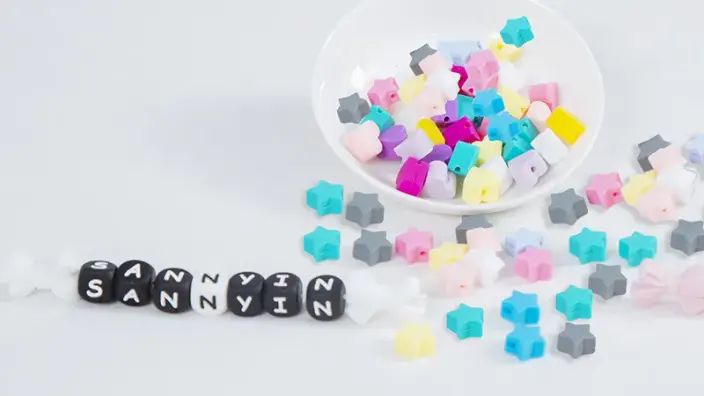
Silicone beads are flexible rather than rigid, but “soft” is not a complete purchase specification. The feel of a bead depends on its silicone compound and its shape. Ask for an available material grade, a stated hardness scale and a sample before approving a custom order.
A soft feel alone does not establish suitability for a child or for an assembled teething product. Material selection and the safety of the finished assembly are separate questions.
How should you specify bead hardness?
Describe the part and its intended use before choosing a number. A small bead with a hole is not the same test specimen as a flat material sample. Ask the supplier how hardness will be measured and whether the reported result describes the compound or the finished bead.
| Send with your enquiry | What to confirm before ordering |
|---|---|
| Bead drawing, dimensions and hole geometry | The exact version used for sampling |
| Desired firmness or a physical reference sample | Which available compound is a suitable starting point |
| A hardness requirement, if your design already has one | Value, scale, tolerance and measurement method; for example, a Shore value needs its scale identified |
| Intended handling, loading and cleaning conditions | Whether the material and bead design are appropriate for those conditions |
| Colour and decoration requirements | That the approved sample represents the proposed production formulation and finish |
Do not compare two hardness numbers without checking that the scale, specimen and test conditions are comparable. If your design has no established hardness requirement, use samples to define it with the supplier rather than assigning an arbitrary range.
What should a sample approval record include?
Record the material designation, bead version, colour, dimensions, measurement method and the approved reference sample. Agree which dimensions and material properties will be checked for production acceptance. A description such as “as soft as the photo” cannot be inspected consistently.
Shin-Etsu’s silicone rubber properties guide describes how silicone properties vary with material and exposure conditions. It is a background reference, not a specification or test report for SANNYIN beads. Ask for documentation for the actual proposed compound and finished product.
Does softer mean safer for babies?
No hardness value by itself establishes the safety of loose beads, a teether or a pacifier clip. The intended product, age group, assembly, mechanical hazards and applicable market requirements need separate assessment. Do not use a material hardness result as proof that an assembled baby product is safe.
For the manufacturing sequence, read how silicone beads are produced. To discuss available designs or custom samples, use the silicone beads page and include your drawing and intended use.
Revision note: Reworked the answer around material identification, comparable hardness measurements and sample approval; removed unsupported hardness and safety implications.